

Finance and Accounting: The School That Prepares You for the Careers of the Future
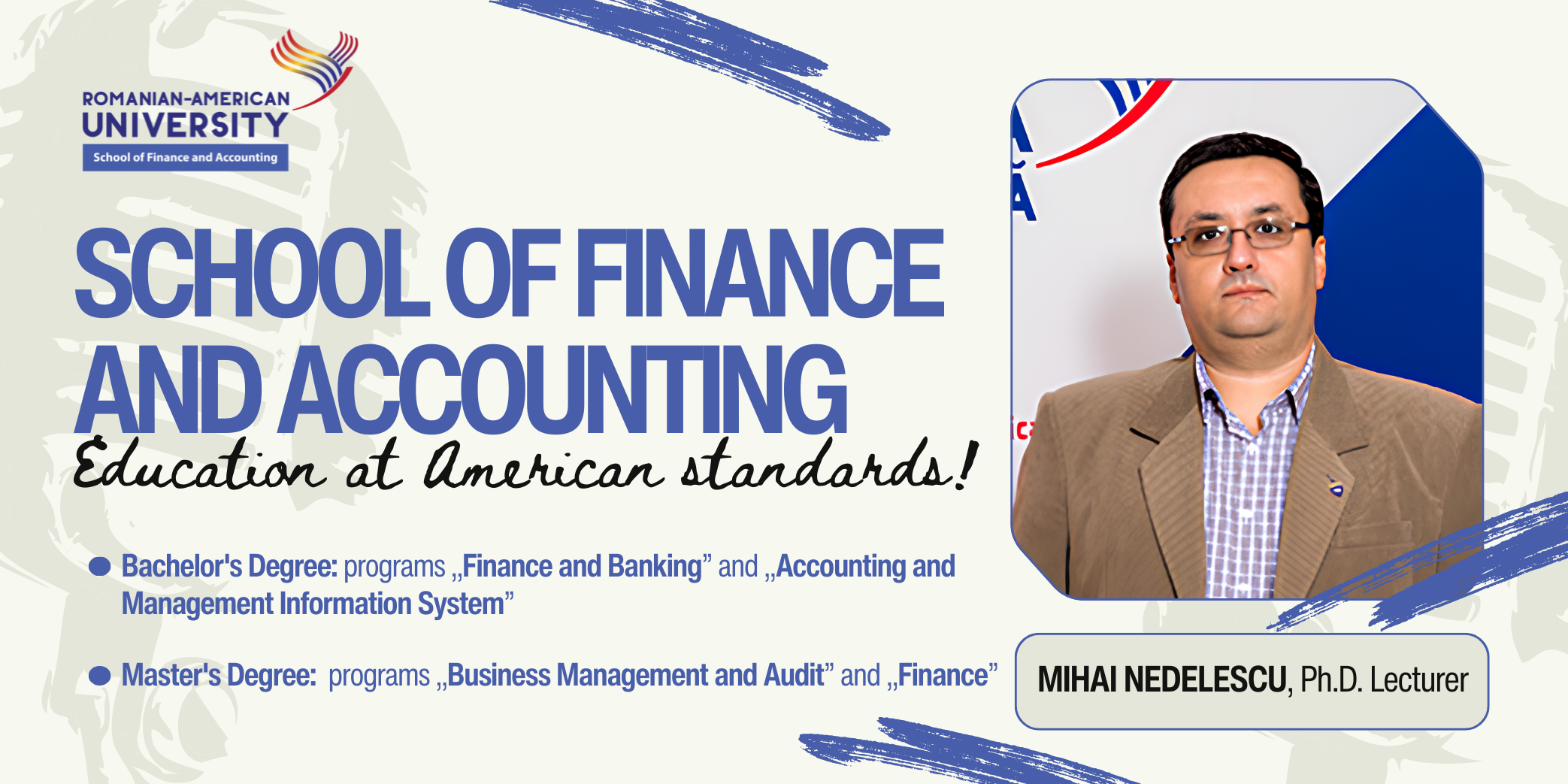
From Fintech and artificial intelligence to professional certifications, practical experience, and industry connections, Mihai Nedelescu, Dean of the School of Finance and Accounting, explains how this field goes far beyond numbers and prepares students to build successful careers in a rapidly evolving world.
Mr. Dean, finance and accounting are often perceived by high school students as rigid fields, full of numbers and paperwork. How would you describe the new face of this field in 2026? What do students learn at the Romanian-American University that shows them this field is actually the language of business and a strategic decision-making tool, rather than just mathematical calculus?
This perception regarding finance and accounting is outdated. Currently, we are talking about a field deeply connected to technology, which includes: accounting process automation, the use of artificial intelligence, and data analytics to substantiate business strategies. Nowadays, this field is not about how to keep records, but about how to build the future of an organization. And our students learn exactly this: to transform numbers into vision and information into strategy.
At the Romanian-American University, we show students that both finance and accounting are, essentially, the language through which a business tells its story and plans its future. The financial-accounting field is not just about recording numbers, but about interpreting data and turning it into useful information for decision-makers.
Therefore, at the School of Finance and Accounting, students do not just learn mathematics, but focus on:
- Understanding economic mechanisms;
- Analyzing performance and identifying a company’s risks and opportunities;
- Building investment budgets;
- Utilizing digital tools and financial analysis software;
- Interpreting economic indicators within a globalized and volatile context;
- Assuming responsibility in decision-making.
The financial world is undergoing a digital revolution – we are talking about Fintech, cryptocurrencies, and the automation of accounting processes. How is the school’s curriculum adapted to these realities? Do students learn to work with current software (ERPs, accounting programs)?
The financial world is in an accelerated process of transformation, and the school’s curriculum is permanently adapted to respond to these digital realities through an integrated approach, both theoretical and practical. Thus, the curriculum is designed to train specialists who not only understand classic financial concepts but can also operate efficiently in a digitalized, dynamic, and technology-driven environment.
This adaptation process involves:
- Integrating Fintech concepts and financial innovation: Students study business models, electronic payments, crowdfunding platforms, and open banking, with an emphasis on understanding the Fintech ecosystem and its impact on the traditional banking system.
- Automation and digitalization of accounting processes: Students learn to work with specialized software for accounting, financial analysis, and reporting, understanding how automation reduces errors and increases operational efficiency.
- Data analysis and digital skills: Data analytics and basic notions of applied programming in finance are becoming essential skills for students, with the focus being on interpreting data to substantiate managerial decisions.
- Partnerships with the business environment: Students must be directly connected to market demands. This is made possible through partnerships developed by the school with banks, consulting firms, and companies for internships, workshops, and applied projects.
There is a fear that you need to be a math whiz to succeed here. What type of young person does this school actually suit? Are you looking for pure mathematicians or rather organized, analytical youth with logical thinking and attention to detail?
The fear that you must be a math whiz to become a student at a finance and/or accounting school is exaggerated. In reality, economic schools do not look for mathematicians, but for students who:
- Have logical and structured thinking;
- Are attentive to details;
- Are persevering and responsible;
- Prefer logical reasoning over rote learning;
- Accept intellectual challenges.
For a future economist, mathematics is a tool, not an end in itself. The important thing is to understand the logic behind the formulas, not to memorize them, because many economic concepts are learned from scratch, step by step.
A major advantage in this field is represented by professional certifications such as ACCA or CECCAR. Does graduating from your school offer students exemptions or a faster start in obtaining these credentials, which are extremely valuable for a top CV?
A major advantage in this field is represented by the cooperation agreements signed by the school with ACCA and CECCAR, which facilitate graduates’ access to top management positions within companies and organizations with national and international activity, while also ensuring greater mobility in practicing financial-accounting professions both at home and abroad.
Thus, the School of Finance and Accounting offers students modern university training programs that meet the specific requirements of national and European financial-accounting practice, as well as the regulations specific to partner professional bodies, such as:
- Association of Chartered Certified Accountants – ACCA: A program accredited in 2015. Graduates were initially exempted from examinations F1, F2, F3, F7, F8, and F9, and since 2016 they also benefit from the recognition of the F5 module.
- Body of Expert and Licensed Accountants of Romania – CECCAR: Exemptions are offered for the subjects related to the internship admission exam, which gives graduates the opportunity to enroll directly into the internship to obtain the status of expert accountant, without the need to take additional exams.
What mobility opportunities (Erasmus, study visits) do your students have? How important is it for a future financier/accountant to see how economic systems work in other European countries?
International mobilities contribute both to the accumulation of knowledge and to forming a global perspective — which is essential for a future financier or accountant. Mobility opportunities for our school’s students represent an essential pillar of academic training in the financial-accounting field.
Thus, through the Erasmus+ program, they can benefit from:
- Study mobilities at partner universities;
- Placement mobilities (internships) in companies, financial institutions, banks, or international organizations;
- Summer schools;
- Blended intensive programs;
- Intercultural experience and development of language skills.
For a future specialist in finance/accounting, international exposure is not just an advantage, but a necessity that ensures: an understanding of the diversity of economic systems, comparative thinking, adaptability, international networking, and increased competitiveness on the labor market. Contact with professors, professionals, and peers from other countries creates long-term professional opportunities. International experience is highly valued by employers, especially in the financial sector, where globalization plays a central role.
Beyond theoretical courses, what practical activities do you offer students? Do you organize stock market trading simulations, case study competitions, or meetings with experts from banks and multinationals, so that students can feel the pulse of the market while still in college?
Beyond theoretical courses, we place great emphasis on practical experience, precisely so that students come into direct contact with the realities of the financial and business market. Therefore, we constantly invite specialists from banks, investment funds, and multinational companies to hold workshops on: corporate finance, risk analysis, audit and consulting, as well as digital transformation in banking.
We also encourage involvement in practical placements and internships, many of which later turn into job opportunities. Our objective is that, by graduation, students possess not only solid theoretical knowledge but also practical experience, confidence in decision-making, and a real understanding of financial market mechanisms.
The financial-accounting field is one of the most stable on the job market. How close is the connection with major employers – I am referring here to the Big 4 companies (Deloitte, PwC, EY, KPMG) or banks? Are there dedicated internship programs through which your students end up working in these companies?
The connection between the financial-accounting field and major employers (consulting firms or banking institutions) is very close, and this connection manifests itself both on the job market and through educational collaborations and internship programs. For students, such programs can represent a direct gateway to employment in these organizations (Deloitte, PwC, EY, KPMG), which are permanently looking for young accountants, auditors, financial consultants, or analysts.
Currently, the school has partnerships with consulting firms and banking institutions, materialized in internship programs, practical collaborations within courses taught by industry specialists, and workshops.
Furthermore, at the university level, recruitment events and career fairs are organized periodically, where major companies from the financial-accounting field constantly participate, offering our students:
- Real access to jobs in the industry before graduation;
- Practical experience and networking with professionals;
- Applied knowledge (software, procedures);
- Higher chances of employment after completing their bachelor’s/master’s studies.
For parents and young people wondering about the future, what are the real career prospects? What can a graduate of this school become? Do you also prepare them for roles as financial analysts, auditors, tax consultants, or even Chief Financial Officers (CFOs)?
For both parents and youth, it is important to emphasize that university is the beginning of the road, not its end. A career is built through experience, involvement, and continuous development. The school offers its students a solid foundation in accounting, finance, taxation, and economic-financial analysis, develops their analytical and digital skills, and facilitates their access to internships and prestigious professional certifications.
To the question “What can you become after graduation?”, if we talk about the finance-accounting field, the prospects are real, diverse, and well-anchored in the job market. A well-prepared graduate has the opportunity to work in corporations, entrepreneurship, or freelancing, where they can occupy over time positions such as:
- Financial Analyst: In companies, banks, or investment firms; analyzes financial data, makes forecasts, and supports strategic decisions.
- Auditor: In audit firms or internal control departments.
- Tax Consultant: In specialized firms or independently; offers advice on tax optimization, legislation, and compliance.
- Accounting Specialist / Expert Accountant: In specialized firms or independently.
- Financial Manager / Controller: In companies; coordinates budgets, cash flows, and their financial performance.
- Chief Financial Officer (CFO): A top management position, achieved after gaining relevant experience.
The school provides the foundation, while professional evolution and certifications (such as ACCA or CFA) successfully complete this journey.