

The Future of IT: Cutting-Edge Technology and Management at the School of Computer Science for Business Management
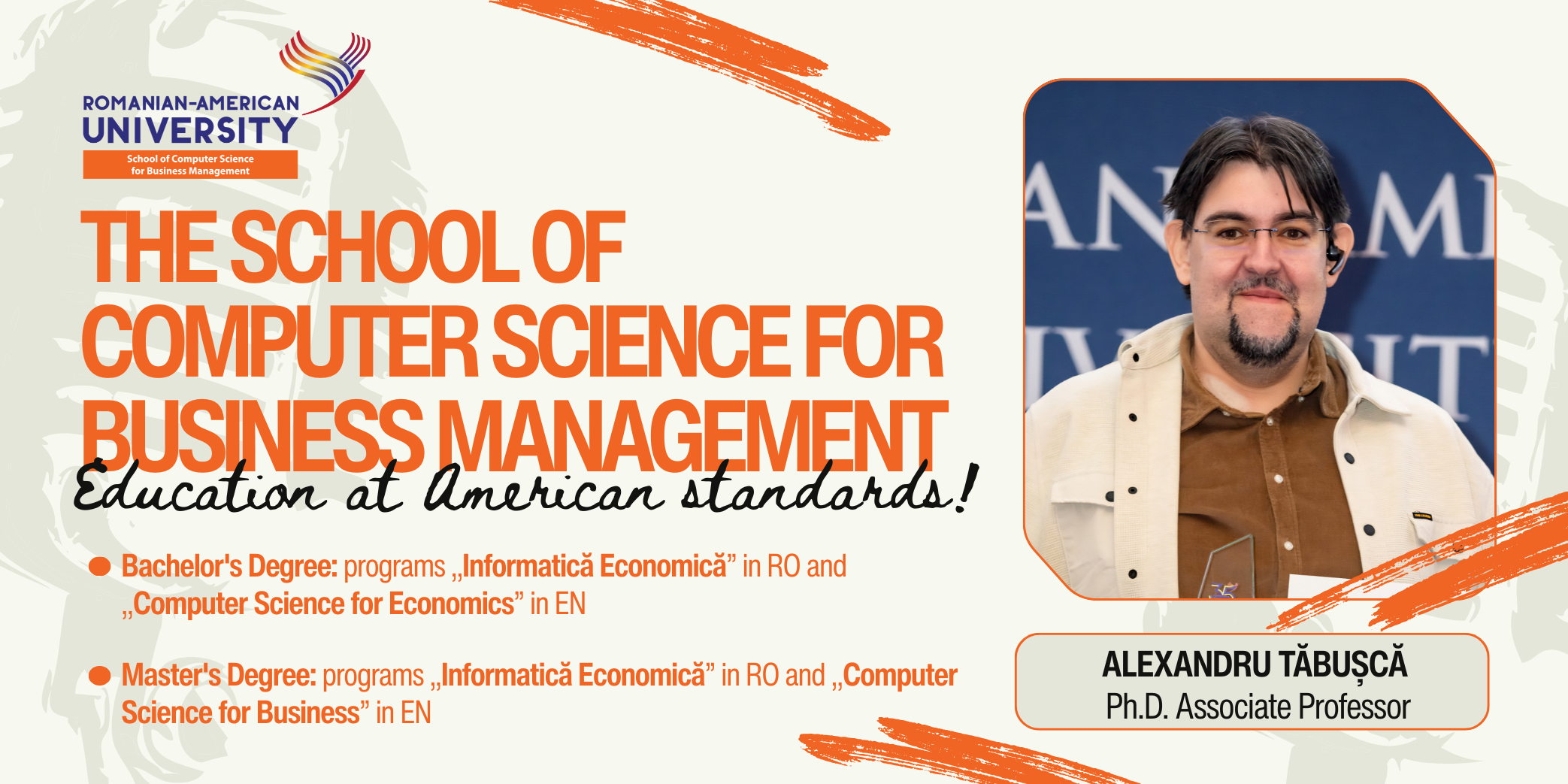
Ph.D.Associate Professor Alexandru Tăbușcă, Dean of the School of Computer Science for Business Management, explains how modern programming languages and artificial intelligence blend with international certifications and rapid integration into the job market.
“Will I be a programmer or a manager?” – What is the identity of Computer Science?
The School of Computer Science for Business Management stands between two worlds: technology and business. We do not just train programmers, nor do we just train managers – we shape professionals capable of understanding technology and transforming it into real digital products. Our students learn to write functional and well-structured code, design complete applications, manage an IT project from start to finish, and understand the user, the market, and the product’s impact. In other words: we do not produce “coders” who simply execute tasks, but we prepare creators of digital solutions. It is the ideal specialization for young people who want access to the entire IT ecosystem, not just a highly technical niche.
How does the school ensure that the curriculum remains up to date?
Technology changes annually, sometimes even monthly. That is why we update the curriculum every year, in consultation with IT companies, alumni, and industry experts. Students learn modern languages used in companies today, such as Python for data analysis, AI, and security; JavaScript / TypeScript for full-stack web development; Java for enterprise back-end; SQL / NoSQL for modern databases; and C# / .NET for business applications. And, very importantly, they study current technologies: Cloud computing (Azure, AWS, Google Cloud), Machine Learning, DevOps, Cybersecurity, and modern front-end frameworks (React, Angular). Our goal is simple: when a student finishes a course, what they have learned is usable as soon as tomorrow in an IT company.
What type of young person is a good fit for this school?
Our school is suitable for several types of students, starting with those passionate about technology and programming, young people with logical thinking, and the curious ones who want to understand “how an application is built.” It also fits creative individuals interested in design, innovation, and digital products, as well as students who want to work in IT, but not necessarily strictly as programmers. You do not need to be a “math genius.” You need discipline, curiosity, a desire to constantly learn, and perseverance. The rest, we build together.
Do you also develop soft skills?
Yes, we develop soft skills because they are just as important as technical skills. In the IT industry today, companies look for people who know how to explain an idea, can work efficiently in a team, can talk to a client, can lead an Agile project, and know how to organize and prioritize requirements. That is why, within the school, students participate in Agile project simulations, presentations, pitches, demos, communication and leadership activities, as well as group projects with different roles, such as developer, tester, or product owner. A graduate who hasn’t sufficiently trained their soft skills always leaves half of their potential unused.
How do you integrate AI into the learning process?
Artificial Intelligence is not the future, it is the present. So, we use it primarily in programming, where students learn how to use AI as an assistant for code writing, debugging and optimization, automated testing, and documentation generation. We also use it in data analysis, employing AI models for predictions, classifications, recommendations, and process automation. Last but not least, we integrate it into projects, and our students’ projects already include components of computer vision, NLP, business analysis with AI models, and smart web applications. Our goal is for students to become smart consumers of AI, not just superficial users.
What facilities exist on campus and what certifications can students obtain?
The Romanian-American University features a modern campus with IT labs equipped to international standards, AI and 3D printing/modeling labs, study rooms, creative hubs, co-working spaces, and access to professional software licenses (Microsoft, JetBrains, Autodesk, etc.). Regarding certifications, the school has partnerships for major credentials such as Microsoft (Azure, Power Platform), Cisco (networking, cybersecurity), Google (Cloud, Analytics), ICDL (3D printing, AI, Office software), UIPath (enterprise software automation), and Tailent (SME software automation). Students can obtain these certifications right during college, which provides a major advantage when hiring.
How closely linked is the school to the industry?
We have very close ties with the business environment. We maintain active partnerships with IT companies in Bucharest and beyond. We annually organize hackathons and themed competitions, workshops delivered by partner companies, technical visits to IT firms, industry-collaborative projects, and real-world internships, not just “on paper.” Quite often, employment begins in the 2nd or 3rd year for some of our students as a direct result of these collaborations.
What real careers do graduates of the School of Computer Science for Business Management have?
Our graduates do not just become programmers – though many do choose this path. Doors are open in practically any field, and here I will mention just a few very common positions. In the technical area, you can find roles such as Software Developer, Web Developer (front-end / back-end / full-stack), Data Analyst, QA Tester, Cybersecurity Analyst, and Cloud Engineer. In the analysis and management area, they can work as a Business Analyst, Product Owner / Product Manager, Project Manager, IT Consultant, or Digital Transformation Specialist. Additionally, in the innovation zone, they can become tech entrepreneurs, application or startup creators, and applied AI specialists. The School of Computer Science for Business Management is one of the few specializations that give you the flexibility to choose between tech, business, or a combination of both.