

International Scientific Conference”Human Rights at Risk: Organized Crime at Sea and Across Borders (OC-SAB)”
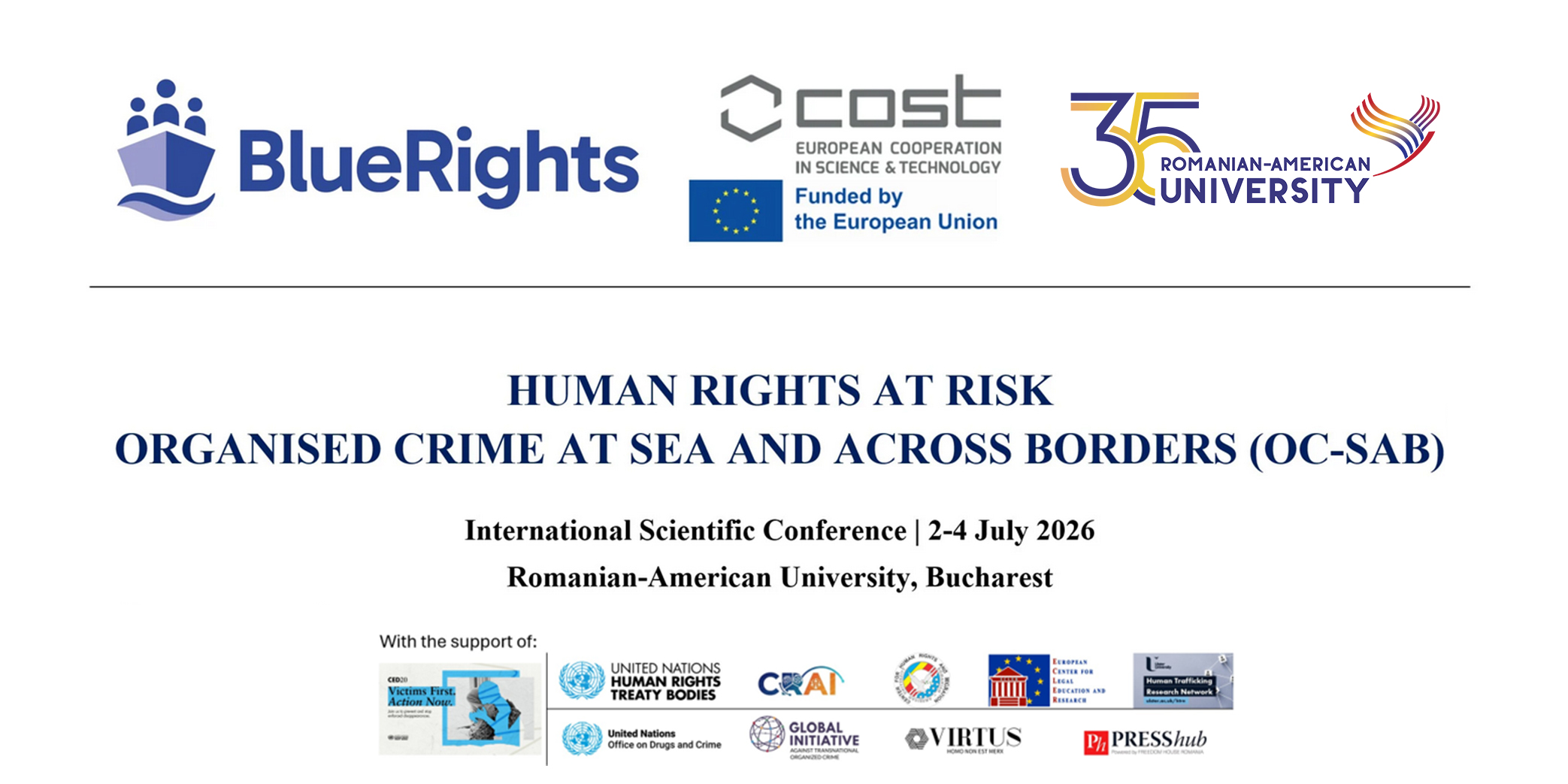
The Centre for Human Rights and Migration of the Romanian-American University in Bucharest is organizing the global scientific conference “Human Rights at Risk: Organized Crime at Sea and Across Borders (OC-SAB)”, with the support of the United Nations Office on Drugs and Crime (UNODC), the UN Human Rights Treaty Bodies through the UN Committee on Enforced Disappearances, the Global Initiative Against Transnational Organized Crime (GI-TOC), and other international groups of researchers specializing in human rights and organized crime.
The conference is organized within the framework of COST Action CA23103 – “Life, Liberty and Health: Ensuring Universal Protection of Human Rights at Sea (BlueRights)“, a global network of experts in the field of human rights funded through the Horizon Europe research programme. Following a competitive international selection process, the organization of this event was entrusted to Silvia Tăbușcă, international expert in human rights and the prevention of organized crime, and Director of the Centre for Human Rights and Migration at the Romanian-American University.
The conference will be held in a hybrid format, allowing participants to attend both in person at the Romanian-American University in Bucharest and online via Microsoft Teams. The event will bring together more than 250 academics, researchers, practitioners, policymakers, representatives of international organizations, and experts engaged in addressing challenges related to the protection of human rights, transnational organized crime, and national security. It provides an important global platform for interdisciplinary dialogue, the exchange of expertise, and the strengthening of international cooperation in combating organized crime and protecting fundamental rights.
In this context, we are honored to announce that the conference programme will feature distinguished keynote speakers, internationally recognized for their outstanding contributions to international human rights law and the prevention of organized crime. The conference program is structured around two thematic panels: “Organized Crime” – Thursday, 2 July and “Human Rights” – Friday, 3 July. Both panels will begin at 10:00 AM in Room 017 of the Romanian-American University in Bucharest.
Professor Joe Cannataci, Former United Nations Special Rapporteur on the Right to Privacy
We are honored to announce the participation of Professor Joe Cannataci, former United Nations Special Rapporteur on the Right to Privacy, as a keynote speaker at our conference taking place from 2–4 July 2026.
Internationally recognized as one of the world’s leading authorities on privacy protection, personal data protection, cybersecurity, and digital rights, Professor Cannataci has played a pivotal role in shaping global debates on safeguarding fundamental rights in the digital age.
As the first United Nations Special Rapporteur on the Right to Privacy, he made a significant contribution to the development of international standards and policies addressing the challenges posed by emerging technologies, digital surveillance, artificial intelligence, and cross-border data governance.
We are privileged to welcome him and look forward to his keynote address and the valuable insights he will share with participants and the international community.
Ilias Chatzis, Acting Director of the Organized Crime Branch and Chief of the Human Trafficking and Migrant Smuggling Section, UNODC
We are honored to announce the participation of Mr. Ilias Chatzis, Acting Director of the Organized Crime Branch and Chief of the Human Trafficking and Migrant Smuggling Section at UNODC, as a keynote speaker at our conference from 2–4 July 2026.
With decades of experience coordinating international efforts to combat trafficking in persons and the smuggling of migrants, Mr. Chatzis has played a key role in shaping international policies, strengthening criminal justice responses, and promoting international cooperation against organized crime.
His expertise in preventing and combating serious forms of transnational crime represents a valuable contribution to discussions on current challenges related to organized crime, global security, and the rule of law.
We are honored to welcome him and look forward to his keynote address, as well as to the dialogue and reflections it will inspire among participants and the international community.
Judge Iulia Motoc, Member of the Institute of International Law, Judge of the International Criminal Court, and Former Judge of the European Court of Human Rights
Judge Iulia Motoc is one of the most distinguished figures in contemporary international law, human rights, and international criminal justice.
Throughout her remarkable career, she has made significant contributions to the development of international legal standards, the strengthening of the protection of fundamental rights, and the promotion of accountability for the most serious international crimes.
Her work at the European Court of Human Rights and, currently, at the International Criminal Court reflects an exceptional commitment to justice, the rule of law, and the protection of human dignity.
We are privileged to welcome her and look forward to her keynote address and the valuable perspectives she will share with participants and the international community.
Juan Pablo Albán Alencastro, Chair of the United Nations Committee on Enforced Disappearances
In this capacity, Mr. Albán Alencastro plays a key role in promoting the implementation of the International Convention for the Protection of All Persons from Enforced Disappearance and strengthening international efforts to prevent and combat one of the gravest human rights violations, often associated with organized crime.
Throughout his distinguished career as a human rights expert, academic, and lawyer, he has made significant contributions to strengthening international human rights protection mechanisms and promoting accountability, justice, and the rights of victims.
His participation is particularly significant as 2026 marks the 20th anniversary of the adoption of the International Convention for the Protection of All Persons from Enforced Disappearance and the launch of the global CED20 campaign, under the theme “Victims First. Act Now.”
H.E. Beata Stoczyńska, Ambassador and Executive Director of the Asia-Europe Foundation (ASEF)
Ambassador Beata Stoczyńska brings extensive diplomatic experience and an outstanding career dedicated to promoting dialogue for democracy, cooperation, and partnerships between Asia and Europe.
As Executive Director of ASEF, she leads initiatives aimed at strengthening collaboration among governments, academic institutions, civil society organizations, and other international stakeholders, contributing to the development of innovative responses to global challenges.
Her expertise in international relations and interregional cooperation provides valuable insights into the interconnected nature of contemporary challenges related to organized crime, security, governance, and human rights.
Cristiana Macchiusi, Justice Attaché at the Embassy of Italy in Romania and Anti-Mafia Prosecutor
With extensive experience in combating organized crime and mafia-related criminal activities, Ms. Cristiana Macchiusi has made significant contributions to strengthening judicial cooperation, advancing criminal investigations, and promoting effective legal responses to the complex threats posed by transnational organized crime.
Her experience, gained both as an anti-mafia prosecutor and as Justice Attaché, offers a particularly valuable perspective on cooperation between national and international authorities in the fight against organized crime.
Irina Năstase, National Program Manager, International Centre for Missing & Exploited Children (ICMEC)
Through her work at ICMEC, Ms. Irina Năstase is actively involved in developing and implementing initiatives dedicated to protecting children from abuse, exploitation, and online risks. Her work contributes to strengthening multidisciplinary cooperation, supporting institutional capacity-building efforts, raising public awareness, and promoting child-centred approaches aimed at safeguarding children’s rights and well-being.
In addition, her work supports initiatives to strengthen the resilience and mental well-being of professionals involved in investigating cases of child exploitation and sexual abuse.
More details about the event are available here: Agenda July 2 | Agenda July 3 | Agenda July 4.