


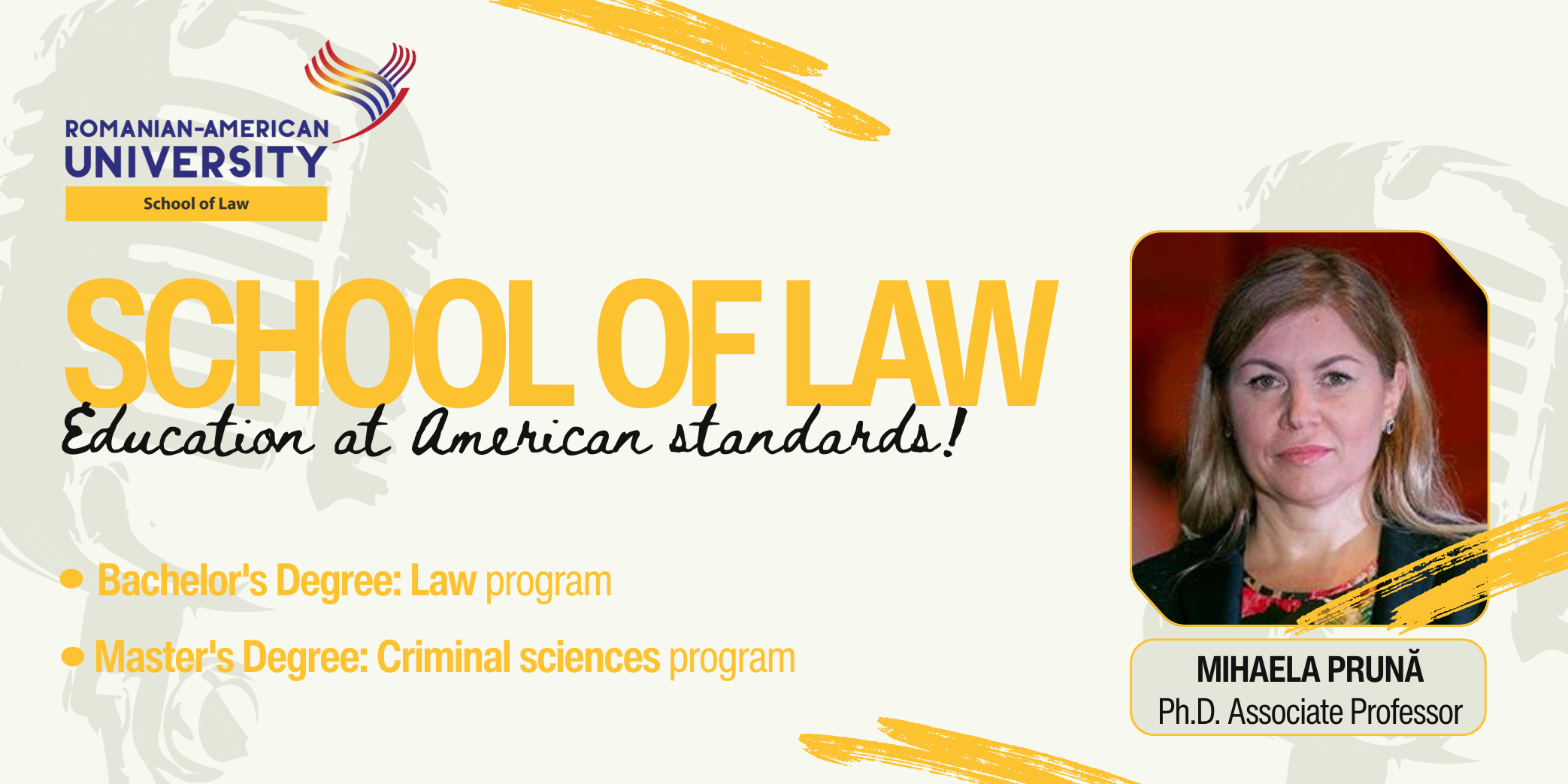
Justice Beyond Codes: Critical Thinking, Practice, and Future Skills
Mihaela Prună, Ph.D. Associate Professor, Dean of the School of Law, explains how theory is transformed into legal reality and how students are prepared to meet the demands of the modern job market. Furthermore, looking beyond standard coursework to expand student involvement and create new opportunities, the faculty organizes prevention campaigns, programs in refugee law, internships, and Erasmus study mobilities.
Madam Dean, the study of Law is often perceived as arid, based on memorizing many laws and codes. If you were to describe the essence of your programs, how do you manage to make this field attractive and logical for students? How does the approach of the School of Law at RAU differentiate itself from traditional state faculties?
Indeed, we still often hear this interpretation according to which Law means memorizing articles of law and reproducing them in exams. In reality, Law is, first and foremost, an exercise in logic, analysis, and argumentation. Laws change, but what remains relevant is the capacity to interpret legal norms and to find solutions for concrete situations.
At the School of Law of the Romanian-American University, we emphasize understanding legal mechanisms and the practical application of knowledge. In addition to the activity during courses and seminars, our students have the opportunity, right from their first year of study, to work additionally with professors as well as with practitioners – lawyers, magistrates – to develop their critical thinking and legal argumentation skills.
We promote a personalized education, centered on the student’s needs by identifying each individual’s potential and orienting them toward competencies that will bring them future success in the labor market.
The University bears the mark of the American educational model, which is famous in the legal field for its pragmatism. How is this reflected in the curriculum? Do you place emphasis on ‘Legal Clinics’ or moot courts to complement theoretical courses?
The American educational model promotes learning through practice and active participation, and this principle is also reflected in our activity. Beyond theoretical courses, students participate in case studies, moot courts, debates, and practical activities that bring them closer to the reality of the legal profession. We encourage them to have initiatives, to come up with proposals for legal projects, and we support them in implementing them. Students are an active part of many projects in partnership with public and private institutions, thus having the opportunity to deepen their fields of interest. Combating human trafficking, preventing illicit substance abuse, equal opportunities, or refugee law are just a few of the topics that our students study in direct collaboration with national public authorities and international institutions.
At the same time, we offer students the opportunity to work directly with practitioners from the legal field and beyond – forensic psychology, forensics, diplomacy, communication, international relations, etc. – to understand the application of the law in concrete social contexts.
What type of person fits this faculty? Beyond the desire to achieve ‘justice’, what traits should a 12th-grade student have – perhaps analytical thinking, a passion for debate, or attention to detail – to excel at Law within RAU?
If we refer to the School of Law of the Romanian-American University, it addresses curious young people who want to explore the mechanisms that govern the world they live in, but who are also eager to learn about the future, about the world they are preparing for. At the same time, our faculty belongs to enthusiastic young people with initiatives, who look for an environment open to collaboration, who want to develop themselves, and who see their professors as real dialogue partners in their journey toward a successful legal career.
Generally speaking, a candidate for Law should have analytical thinking, the capacity to build logical arguments, attention to detail, and an interest in communication. Also, a critical spirit and the willingness to learn continuously are qualities that will help them excel both in faculty and in their career.
At the end of the four years of study, what ‘toolbox’ does a graduate leave with? In addition to knowing the legislation, what soft skills (rhetoric, logical argumentation, legal drafting) do you emphasize, so that they are prepared for the demands of a law firm or a multinational company?
The graduate of the School of Law does not leave only with a consistent baggage of legal knowledge, but also with a set of transferable skills, highly valued on the labor market. This is the reason why we notice that a Law graduate successfully handles a career in many other fields of activity, not just the legal one.
In our School, students learn to analyze complex problems, identify solutions, and support their point of view in a professional manner. We emphasize the development of logical argumentation capacity, communication and negotiation skills, and strategic thinking. This approach translates into multiple competencies that allow graduates to successfully face professional challenges, whether we are talking about activity in a law firm, a multinational, a public institution, or an international organization.
Although Law is a field strongly anchored in national legislation, we live in a connected world. What mobility opportunities (Erasmus, study visits) do your students have, and how important is it for a future jurist to also understand European law or international legal systems?
In the current context, no jurist can view the law exclusively through the prism of national legislation anymore. Globalization generates increasingly complex legal challenges.
Our students benefit from mobility opportunities through Erasmus+ programs, academic exchanges, and the university’s international partnerships. These experiences contribute to the development of a comparative perspective on law and prepare them for a professional environment where international collaboration is becoming increasingly important. Year after year, students participate in courses with foreign professors, having the opportunity to explore transdisciplinary perspectives that complete their training as future jurists.
What extra-curricular opportunities does the faculty offer? Are there student associations, moot court competitions, or scientific circles where students can start building a professional network while still in faculty?
Extra-curricular activities are an important element for our students’ training. I believe that the university experience should not be viewed as a rigid path entirely established by the institution, but as a development process built in partnership with the student. Our faculty offers them the academic framework, resources, opportunities, and guidance necessary, but each student shapes their own path according to their interests, skills, and professional goals. University life is built day by day, through active participation, dialogue, involvement in projects, and practical activities. Therefore, we offer them an open and flexible environment, where students are encouraged to explore, to assume responsibility for their own training process, and to contribute actively to their own development. Our students are involved in extracurricular activities, from social responsibility campaigns to combat Human Trafficking and prevent drug abuse, carried out in partnership with the National Agency against Human Trafficking and the National Agency for Public Policies and Coordination in the Field of Drugs and Addictions, to international conferences organized in collaboration with national partners and European institutions.
How close is the faculty’s connection with law practitioners? Do you have partnerships with law firms, notary offices, or public institutions for internships, so that students can see what a real case file looks like before finishing faculty?
We believe that the training of a good jurist requires a permanent dialogue between the academic environment and legal practice. Therefore, we collaborate with lawyers, magistrates, notaries, judicial executors, legal counselors, and representatives of public institutions. They are present as guests in courses and seminars. Together with them, we organize workshops and seminars to deepen topics that have a significant impact on legal practice.
Students participate in internships right from their first year of study, going to court together with practitioners and studying files, which allows them to understand how theoretical knowledge is applied in real situations.
For a parent wondering ‘What will my child do after graduation?’, what are the career horizons? Do you prepare students only for the classic admission exams for the Bar and Magistracy, or do you also orient them toward careers as legal counselors in companies, business consultancy, or European institutions?
The School of Law offers one of the most resourceful university trainings. Of course, many graduates choose to pursue a career in legal professions as a lawyer, magistrate, notary, judicial executor, clerk, or legal counselor, but the professional opportunities are much broader.
We have graduates who have a successful career in foreign affairs or internal affairs, European funds consultancy, public procurement experts, business consultants, insolvency practitioners, public administration, etc.
Legal training is highly valued in the business environment, in national and multinational companies, in public institutions, non-governmental organizations, European or international bodies.
In an increasingly regulated society, legal skills represent a significant competitive advantage. Therefore, our objective is to train adaptable professionals, capable of capitalizing on the opportunities of a labor market undergoing continuous transformation.