

From Ideas to Impact: How the School of Management-Marketing Shapes Students into the Leaders of Tomorrow’s Economy
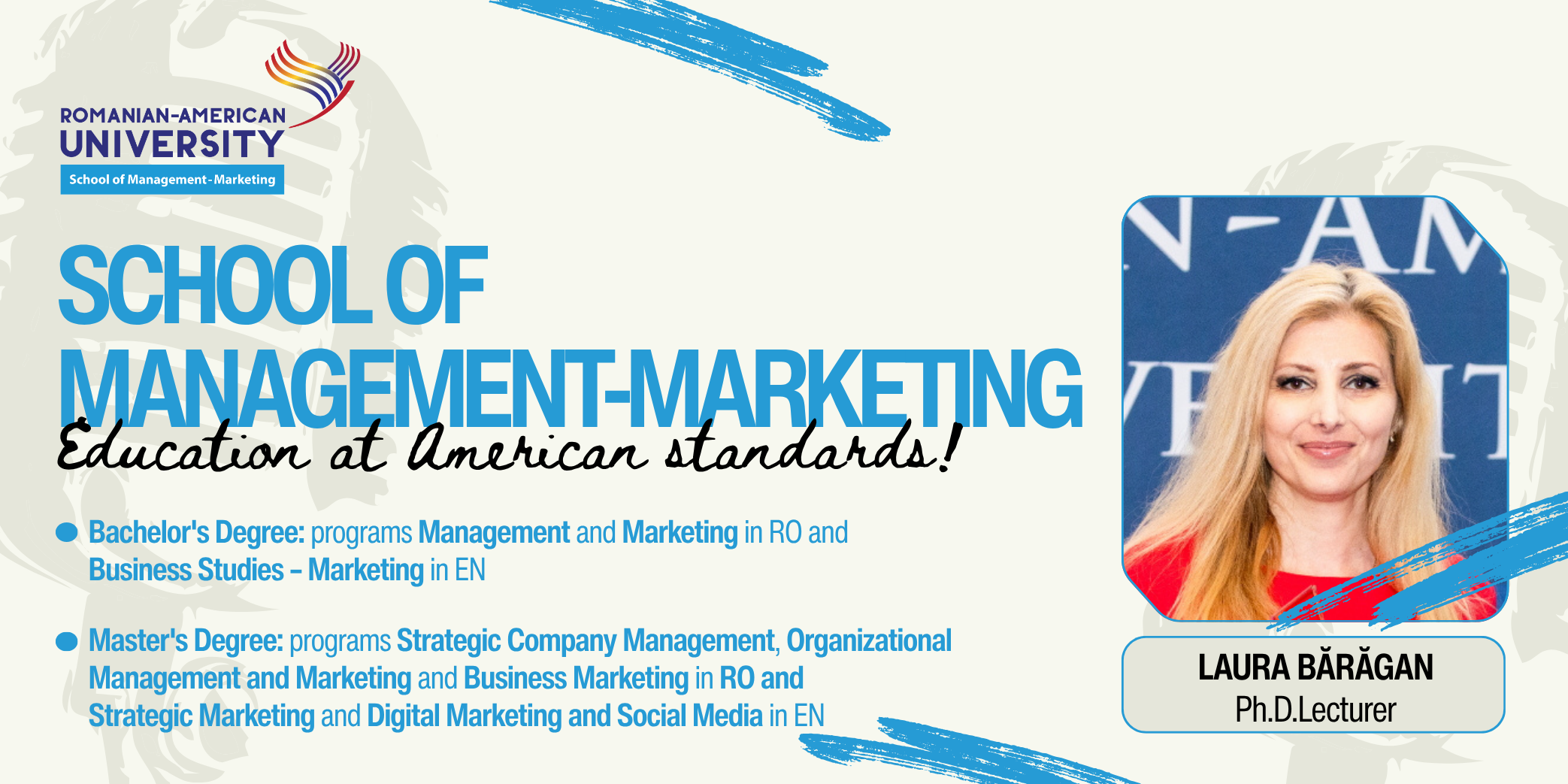
How digital marketing, strategic thinking, networking, and hands-on experience come together to prepare graduates to excel in companies or launch their own businesses. Laura Bărăgan, Dean of the School of Management-Marketing, discusses applied education, the entrepreneurial mindset, and the skills through which students learn to turn ideas into strategies and projects with real impact.
The Management and Marketing are fields that are constantly reinventing themselves. Today, we no longer talk only about TV commercials, but about Digital Marketing, Social Media, and E-commerce. How have you updated the curriculum to reflect these changes? Do students learn to use concrete digital tools, such as Google Ads, Analytics, or CRMs, as early as college?
The Management and marketing have always been dynamic fields, but today the pace of change is much faster. We can no longer talk about marketing simply as promotion, advertising, or sales. We are talking about data, consumer behavior, online communities, brand experience, e-commerce, artificial intelligence, and the ability to understand very quickly what is changing in the market.
This is why course syllabi must keep pace with reality. Students no longer just need definitions; they need contexts, tools, and exercises through which to understand how a business decision is made. We work with current examples, case studies, applied projects, and digital tools that are part of corporate reality—ranging from analytics platforms and online promotion tools to CRM concepts, social media, e-commerce, and digital strategy.
For me, however, it is vital that students do not just learn to press some buttons. Tools change. Today it is one platform, tomorrow another appears. What remains essential is that they understand the underlying logic: who the customer is, what problem they have, how to reach them, how to measure results, and how to make data-driven decisions. This is what we aim to build. Not just users of digital tools, but young people who think strategically in a digital world.
The Romanian-American University strongly promotes an entrepreneurial spirit. How is this reflected in your school’s courses? Do students only learn how to be good employees in corporations, or are they also encouraged and guided to launch their own start-ups right from their university days?
Corporations and startups are not two parallel worlds; both need vision, strategy, and marketing. A student from the School of Management-Marketing learns to understand both worlds: both the large organization, with its processes and rigors, and entrepreneurship, with its freedom, risk, and creativity. We do not just prepare them to fill a job vacancy, but to understand how an organization functions and how it can be built.
The role of the entrepreneur is a central pillar in management, representing one of the 10 roles that a manager must fulfill. Students at the School of Management-Marketing understand and assimilate this concept from their very first year of study.
There is no barrier between being a good employee and an entrepreneur. Large corporations are looking for intrapreneurs today—meaning people with a startup mindset who innovate within the company. At the same time, our courses are designed to be applied: students do not just memorize theories, but develop business plans, learn to take risks, and are guided directly toward launching their own startups. We teach them to see opportunities where others see problems, whether they will run their own company or manage large departments in a corporation.
An entrepreneurial spirit does not necessarily mean that every student must open a company immediately after graduation. It means having initiative, seeing opportunities, understanding the market, being able to turn an idea into a project, and a project into a result. These things are valuable in a start-up, in a corporation, in a family business, and in a public organization alike.
Within the school, students are encouraged to design projects, work in teams, create business concepts, analyze markets, test their ideas, and receive feedback. We try to pull them out of the zone where they just wait for information from the professor and move them into a zone where they ask questions, propose solutions, and stand by a point of view.
A young person finishing university should be able to say they worked on projects, understood how a strategy is built, learned to present an idea, received feedback, and improved what they do.
At the School of Management-Marketing, we do not just train mere executors, but leaders capable of generating value wherever they are. We also offer them the American “just do it” mindset, combined with academic rigor. The result? Graduates who are not just looking for a cozy job, but young people who generate jobs for others.
What profile of a young person fits this school best?
The School of Management-Marketing suits curious and enterprising young people. Those who want to understand people, organizations, markets, and how ideas can become real projects.
I do not believe a young person needs to know perfectly, at 18 or 19 years old, what they will do for the rest of their life. It would actually be unfair to expect that from them. University is also a space for discovery. Some come attracted by marketing, communication, social media, or brands. Others discover along the way that they like management, organizing, coordinating and leading teams, analyzing and making decisions based on results, sales, negotiation, or entrepreneurship.
The right profile is that of a young person who has initiative, who wants to learn, who is not only unfazed by change but embraces it, and who is willing to work with people. Management and marketing are, ultimately, about people. About how you understand them, how you communicate with them, how you build trust, and how you create results together.
I would say it is a suitable school for young people who do not want to remain spectators. For those who want to participate, create, get involved, understand, and change for the better the economic world in which they will live and work.
In a world where information is just a click away, employers are looking for attitude and soft skills. What human skills does a graduate leave with? Do you place emphasis on Public Speaking, negotiation, teamwork, and leadership, so that they can lead people, not just processes?
Information is everywhere, but that is precisely why what you do with it becomes more important. A student can no longer be prepared simply through the accumulation of information. They must learn to think, select, argue, communicate, and collaborate.
We place emphasis on human skills because they make the difference in a career. A graduate must know how to speak in front of people, support their ideas, work in a team, negotiate, manage a conflict, understand the motivations of those around them, and take responsibility for a result.
Leadership qualities can shine through before holding a management position in an organization, even during university. They are highlighted when you learn to be reliable, respect your peers, carry your part of a project to the end, and contribute to something bigger than your immediate interest.
I like to tell students that the degree is important, but how they reach that degree is just as important. If during those years they learned to communicate, organize themselves, work with others, and trust their own voice, then they leave university with much more than an official document. They leave with reference points, confidence, and a foundation upon which they can build their own path.
In business, networking is essential. What opportunities do you offer students to interact with the business environment? Do you have Dual Degree programs with foreign universities or Erasmus internships that open their horizons to Western markets?
f we talk about professional networking, it is a skill in itself; it involves communication skills, relationship building, personal presentation, collaboration, and developing useful networks of contacts. It does not just mean knowing people, but learning how to build professional relationships, how to ask questions, how to present yourself, how to stay connected to opportunities, and how to understand what is happening in the market.
This is why the connection with the business environment is very important to us. Students have the opportunity to interact with professionals, entrepreneurs, managers, marketing specialists, people from companies, and graduates who have already gone through the stages they are about to face, through the organization of conferences and guest speakers present in the school’s classes. These meetings are valuable because they bring reality into the classroom. The student begins to see what a career looks like, what is required in an interview, how things work in a company, and what truly matters beyond theory.
The international component is also important. The Romanian-American University has a natural openness toward the international space, and Erasmus mobilities and academic collaborations help students see other educational models and other markets. For a young person, international experience matters enormously. It pushes them out of their comfort zone, helps them communicate better, become more independent, and understand that the labor market does not stop at Romania’s borders.
Regarding double degree programs, these depend on academic compatibility and existing partnerships, but the direction is clear. We want our students to have as many contexts as possible to broaden their horizons and be prepared for a career in an internationally connected economy. This is why, at the School of Management-Marketing level, we are in our second year of running the double-degree bachelor’s program in partnership with the University of York, UK, namely “Business Studies in Marketing”, taught in English, where professors from the Romanian-American University work and teach in partnership with colleagues from the University of York. We also have a double-degree master’s program, “Digital Marketing and Social Media”, also in partnership with the University of York. These bachelor’s and master’s programs offer a unique opportunity in Romania: that of studying at home and obtaining two internationally recognized degrees.
Student life at Management-Marketing should be vibrant. What extracurricular activities are there? Do you organize business idea competitions or periodic meetings with successful entrepreneurs who can become mentors to students?
Student life should not be reduced to classes and exams. Surely, the academic part is essential, but the shaping of a young person also happens outside the classroom, through projects, events, competitions, discussions, volunteering, meetings with business people, and experiences that challenge them to step out of their comfort zone.
I want students to feel that their school is a living place. A place where they can come up with ideas, test concepts, work in teams, organize events, and meet people who inspire them. Idea competitions, applied projects, meetings with entrepreneurs, and practical workshops are very important because they give students an experience they cannot get just by reading a course textbook. At the school level, we have the Management-Marketing Club, whose members participate in activities for the benefit of the institution and various volunteering actions, but also organize extremely interesting and useful activities for themselves.
Mentorship, even in an informal shape, can greatly change a young person’s trajectory. Sometimes, a discussion with an entrepreneur, a graduate, or a manager can clarify a student’s direction for the coming years. Therefore, we try to create as many bridges as possible between students and people who have built something concrete, through invitations to classes and through the biannual organization of conferences on topics related to employment in the labor market, in partnership with Cariere magazine. Both the school’s students and guests from the business environment with leadership positions participate in these, to provide a managerial perspective to the discussions. We also organized a competition for students this academic year: “Manager Challenge – The Future Leaders Hunt”. Students were encouraged to work in teams, collaborate, think strategically, and find solutions even when the map is incomplete.
We also send a biannual invitation to representatives of the Traffic Police Brigade, who honor us with their presence and the open dialogue they have both with the students of the School of Management-Marketing and with all RAU students. The topics are related to preventive conduct in traffic and the rules for road users, referring to drivers, but also to other categories of participants: bicycles, electric scooters, awareness of obligations in the event of being involved in a traffic accident, etc.
The current generation needs to understand the link between what they learn and the world in which they will work. It is no longer enough to tell a young person to learn just because they have to. You have to show them why it matters, how it applies, where it can take them, and what they can build with what they learn.
How connected is the school to the reality within companies? Do you have strategic partnerships through which professionals from advertising agencies or managers from multinationals come to hold practical classes or workshops, bringing real case studies into the classroom?
A school of management and marketing cannot exist isolated from the economic environment. If we talk about business, we must be connected to business. If we talk about marketing, we must understand what is happening in agencies, in communication departments, in sales, in e-commerce, in entrepreneurial companies, and in multinationals.
Therefore, the presence of professionals in the life of the school is essential. We have guests from the business environment in almost every course of the school. They bring real examples, current challenges, case studies, and a perspective that students immediately feel is applied. It is one thing to discuss a marketing campaign theoretically and another to have someone who actually worked on a campaign come and explain what worked, what didn’t, what budget they had, what indicators they tracked, and what decisions they had to make. We have partnerships with Banca Transilvania for practical training periods, with Romarm and the Luxor Group for internships, and with Cariere magazine for organizing conferences with the business environment. At the same time, we have advisory boards with representatives from the business community who come to classes and conferences in direct dialogue with our students; we even had an internship at the Prime Minister’s Cabinet.
Additionally, in this second semester of the academic year, we organized two laboratories: “Sense-Making Labs,” with representatives of the business environment holding leadership positions, whose results will be integrated into case studies during seminar classes. These are Lab 1: “AI & Sustainable Performance” and Lab 2: “AI & Decision-Making”.
I want the student to understand from university that the professional world is not perfectly tidy, like in a manual. In companies, constraints, short deadlines, limited budgets, difficult clients, strategy shifts, and decisions that must be made quickly arise. I believe that we succeed, through the sum of activities, workshops, conferences, and, more recently, the results of the labs organized at the school level, in exposing students to this reality, and they will enter the labor market more prepared and more mature. Partnerships with the business environment are not just a nice addition, but a condition for a relevant education.
For a parent investing in their child’s education, the final result matters most. What are the career directions for your graduates? Where do we find them after graduation: in marketing departments, in sales, as project managers, or running their own family businesses?
I understand the parents’ perspective very well. For a family, choosing a university is an investment of time, energy, trust, and resources. It is natural for parents to wonder what their child will be able to do after graduation.
We find graduates of the School of Management-Marketing in departments of marketing, digital marketing, communication, sales, business development, project management, human resources, consulting, advertising, retail, services, entrepreneurial companies, or multinationals. Some choose to continue family businesses, and others build their own projects.
The advantage of these fields is flexibility. A graduate is not prepared for a single profession with a narrow perspective, but for a set of skills that can be used in many professional contexts. They learn to understand the market, the client, the organization, the team, communication, and decision-making, and these things are necessary almost everywhere.
For me, a good result does not just mean that the student has a job after graduation. It means they have direction, confidence, adaptability, and the desire to keep learning. The labor market will change many times in their lives. The important thing is for them to leave university with a solid foundation, with concrete experiences, and with the feeling that they can build something.
The bachelor’s degree remains an important milestone. It shows that a young person has successfully completed a serious stage. But, beyond the degree, it is the person who is shaped during those years that matters—the way they think, how they communicate, how they work with others, and how prepared they are to take on their own path.