

From Passion to Profession: Turning Sports into a Successful Career
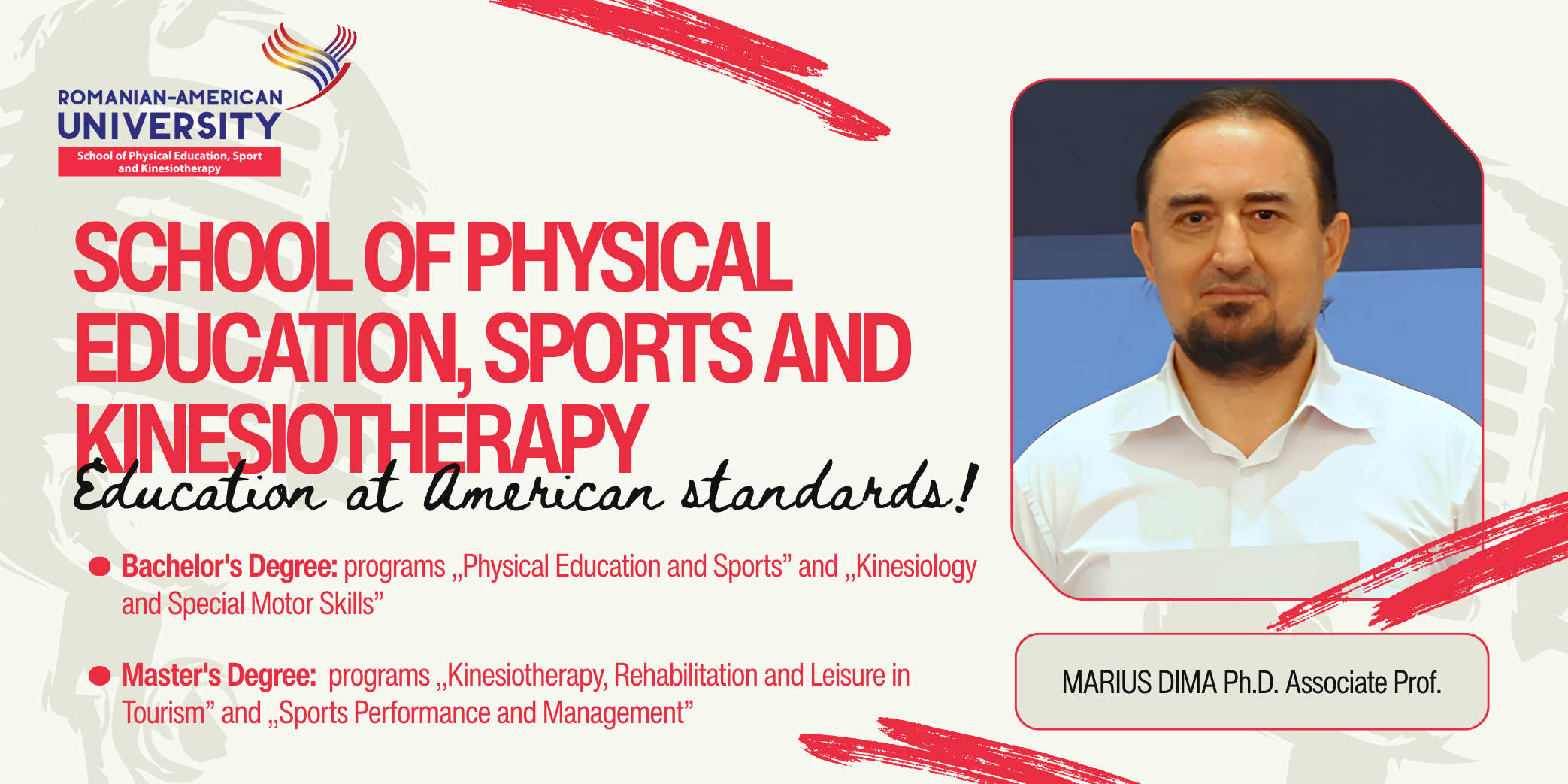
In a field at the border of health, performance and wellness, the School of Physical Education, Sports and Kinesiotherapy redefines professional standards. Marius Dima Ph.D. Associate Prof. talks to us about the opportunities awaiting young people beyond the classroom.
Mr. Dean, the field of physical education and, especially, kinesiotherapy has exploded in recent years. How would you briefly describe the philosophy of your school? What does a student find here that is different from other offers on the market, and how do you balance preparation for sports performance with the scientific rigor required in medical rehabilitation?
Indeed, the field of physical education and, especially, kinesiotherapy have experienced accelerated development in recent years. This is precisely why our philosophy is built on a very clear principle: we train complete professionals, anchored in science, but permanently connected to the practical reality in the field.
At the School of Physical Education, Sports and Kinesiotherapy, we aim to go beyond the classic model in which theory and practice are treated separately. Our student learns from the beginning to think in an integrated way: biomechanically, medically, pedagogically, and psychologically. We do not just train coaches or kinesiotherapists, but specialists capable of understanding the human body as a complex system, placed at the border between performance and health.
What does a student find different here?
Firstly, an applied approach supported by solid scientific foundations. We emphasize understanding anatomical and physiological fundamentals before applying techniques, using modern functional evaluation methods, and developing critical thinking and the ability to adapt interventions to each individual case.
Secondly, we promote a culture of professional responsibility. In kinesiotherapy, for example, it is not enough to “know exercises” – you must understand the pathology, contraindications, rehabilitation mechanisms, and the limits of your intervention. Scientific rigor is not optional, but fundamental.
How do you balance sports performance with medical rehabilitation?
We consider that the two are not opposing fields, but complementary. Top performance is based on principles of prevention, workload control, and correct recovery, while modern medical rehabilitation uses concepts from sports training to restore the patient to their optimal level of functioning.
Therefore, our curriculum is designed so that students in the area of sports performance understand the mechanisms of traumatology and rehabilitation, while kinesiotherapy students master the principles of training and progressive functional re-education.
In short, our philosophy is simple: science, applicability, and professional ethics. We want graduates who not only practice a profession, but also contribute to raising the standards of the profession in Romania and the European space.
The Romanian-American University is known for its campus and modern facilities. How important is the material base (sports halls, kinesiotherapy laboratories, rehabilitation equipment) in the learning process, and how much access do students have to these facilities to practice outside of class hours?
The campus and modern facilities are not just an image element for us, they represent an essential component of the educational process. In a field like physical education, sports, and kinesiotherapy, learning is done through practice, and without an adequate material base, we cannot train competent specialists.
Why is the material base so important?
Because modern sports halls allow students to apply training techniques and familiarize themselves with a diversity of physical activities, from team sports to functional fitness. The kinesiotherapy laboratories are spaces where the theories learned gain meaning – postural assessment, biomechanical analysis, exercise prescription, manual therapy techniques. The rehabilitation equipment and evaluation tools (such as force platforms, dynamometers, electrotherapy, and laser equipment) are indispensable for students to learn not only what to do, but why and how the interventions they propose work.
These resources transform courses into an interactive and applied process, reducing the gap between the classroom and real practice in hospitals, clinics, or sports centers.
Students can use the sports halls and laboratories for practical exercises, group projects, and case studies. Facilities are made available not only during formal hours, but also outside of them, for supervised individual training, open laboratories for practical projects, or preparation for competitions. Program coordinators and teaching staff encourage the responsible use of equipment, with guidance and support, so that every student progresses safely.
In addition, we constantly collaborate with specialized clinics and centers, so that students have the chance to apply what they have learned in real contexts – including outside the campus, in sports teams or through professional internships.
In short: the material base is not just a “plus” – it is a pillar of our training. Modern facilities provide the framework where theory comes to life, and the extended access of students outside of class hours allows
What type of young person are your programs addressed to? Is this school intended exclusively for performance athletes, or is it also suitable for those passionate about sports, anatomy, health, and who want a career in helping others recover physically or in the wellness area?
Our programs are not addressed exclusively to performance athletes – and it is important to emphasize this. Our school is open to all young people who have a real interest in movement, the human body, and health, regardless of whether they come from performance sports or not.
There is, of course, a natural place for athletes who wish to continue their professional path as coaches, fitness trainers, or sports science specialists. Their practical experience is an advantage, but it is not a requirement.
We equally address young people passionate about anatomy, biomechanics, and physiology; those who want a career in kinesiotherapy and medical rehabilitation; those interested in the wellness, fitness, and prevention area, as well as individuals motivated by a genuine desire to help others regain their mobility, autonomy, and confidence in their own body.
In kinesiotherapy, for example, it is not necessary to have been a performance athlete. It is, however, essential to have empathy, patience, the capacity to learn rigorously, and the desire to work with people who are often in vulnerable situations.
Our philosophy is an inclusive one: we look for young people who understand that movement means more than competition. Movement means health, prevention, rehabilitation, balance.
Therefore, the school is suitable both for those who dream of sports performance and for those who want a stable and valuable career in the field of health and well-being.
In short, we address young people who want to transform their passion for movement into a profession with a real impact on people’s lives.
At the end of their studies, what competencies does a graduate leave with “in their pocket”? Beyond anatomy and sports techniques, how much do you emphasize communication with the patient/client, sports psychology, or the use of new technologies in rehabilitation and training?
At the end of their studies, we want our graduate to leave not just with a bag of information, but with a solid set of professional, human, and technological competencies.
Beyond anatomy, biomechanics, and sports techniques, a graduate has “in their pocket”, first of all, applied professional competencies: the ability to perform correct functional evaluations; the design and adaptation of training or rehabilitation programs based on individual objectives and characteristics; understanding the physiological and pathological mechanisms underlying the intervention, as well as applying the principles of prevention and safety in practical activity.
Secondly, there are communication and relationship competencies. We place a real emphasis on communication with the patient or client. A good kinesiotherapist or coach does not just work with muscles and joints, but with people. Our students learn to explain a functional diagnosis or an intervention plan clearly and accessibly, to create a relationship of trust, to manage difficult or demotivating situations, and to adapt their language and approach based on age, education level, or context.
Then we have the elements of sports psychology and motivation. In performance, but also in rehabilitation, the psychological component is essential. We work on motivation mechanisms, stress and anxiety management, supporting adherence to the rehabilitation program, and understanding the emotional impact of injuries or physical limitations.
Equally important is the use of new technologies. Technology is an integral part of our training. Graduates are familiar with modern evaluation and monitoring tools, rehabilitation and electrotherapy equipment, digital applications for tracking progress, and concepts of biomechanical analysis and functional data.
We do not want specialists who mechanically apply a protocol, but professionals who know how to interpret data, correlate information, and make scientifically argued decisions.
In short, our graduate leaves prepared to be a good practitioner, an effective communicator, an ethical professional, and a specialist adapted to current technology.
For us, success does not only mean rapid integration into the labor market, but the ability to build a sustainable career based on competence, empathy, and continuous learning.
Sports and health are universal languages. What international mobility opportunities (Erasmus, internships in clinics abroad) do your students have? Do you encourage them to see how sports management or medical rehabilitation is done in Western countries?
You are perfectly right: sports and health are universal languages. This is precisely why the international dimension represents an important pillar in our academic strategy. We actively encourage international mobility, because exposure to other educational and medical systems develops not only professional competencies, but also maturity, adaptability, and a global vision.
Through the Erasmus+ program, our students can benefit from mobilities both for studies – a semester or an academic year at partner universities in Europe and for placement internships in clinics, rehabilitation centers, sports organizations, or sports management institutions.
These experiences offer them access to modern rehabilitation and prevention methods, advanced technologies used in Western Europe, and different models of organizing sports and medical systems.
In addition to academic mobilities, we support participation in internships in clinics and sports centers abroad, international workshops and conferences, and joint projects with partner institutions.
We encourage them to see “live” how sports management, physical training, or medical rehabilitation is done in countries with tradition and advanced infrastructure. The differences in approach, professional standards, and organizational culture are extremely valuable lessons.
Why is this important? Because we want graduates who can work in a European context, understand the international standards of the profession, and are competitive in the labor market in Romania and abroad.
International experience is not just a travel opportunity, but an exercise in professional and personal development. Students returning from mobilities usually come back with a broader perspective, new ideas, and an increased level of autonomy.
In short, yes – we firmly encourage them to look beyond borders. We believe that a good specialist in sports or rehabilitation must understand global standards in order to contribute to increasing the quality of services in Romania as well.
We know that student life at a profile school means a lot of movement. What extracurricular activities exist? Do you have university teams, sports clubs, or internal competitions where students can feel the team spirit and perform under the university colors?
Student life at a profile school does not stop at courses and laboratories. Movement, competition, and team spirit are part of our institutional DNA.
Through extracurricular activities and sports clubs, students have the opportunity to participate in university teams in various sports disciplines, clubs and training groups for individual and team sports, training sessions coordinated by teaching staff and specialized coaches, and thematic workshops (fitness, physical training, injury prevention, sports nutrition).
These activities are not just recreational – they complement professional training. A student who plays in a university team learns about leadership, collaboration, pressure management, and competitive organization.
Competitions and university representation
We participate in university competitions and interuniversity sports events, where students can represent the university and perform under its colors. In addition, we organize internal competitions that stimulate team spirit and the culture of performance.
For us, sports performance and belonging to the community go hand in hand. The university spirit is built through involvement, fair play, and mutual support.
Beyond competition
Not all students want competitive performance – and this is perfectly fine. There are activities oriented towards wellness and recreational movement, volunteer projects in sports events, and involvement in organizing competitions or activities for the community.
We want every student to find their place – whether they want to compete, coach, organize, or simply exercise in a professional setting.
In short, extracurricular life is a natural extension of academic training. We encourage students to fully live the university experience: to perform, to collaborate, and to build relationships that often become the foundation of their future careers.
How connected is the school to the labor market? Do you have active partnerships with rehabilitation clinics, hospitals, sports federations, or wellness chains where students can do serious internships that open the door to immediate employment?
Connecting to the labor market is not a secondary objective for us, it is a strategic priority. In an applied field such as physical education, sports, and kinesiotherapy, the relevance of training is measured by the graduate’s ability to integrate quickly and competently into a real professional environment.
We have partnerships with medical rehabilitation clinics and physiotherapy centers; hospitals and medical units where students can observe and participate, under supervision, in evaluation and rehabilitation processes; sports federations and clubs; as well as fitness centers and chains in the wellness area.
The internships are not formal, but structured, with clear objectives, evaluation, and professional feedback. Students are involved in real activities: functional evaluations, rehabilitation programs, training assistance, planning, and monitoring.
A significant number of students receive collaboration or employment offers right during their internship period. For employers, the practice is a testing process of competencies, and for the student, an opportunity to demonstrate seriousness, professional ethics, and the ability to integrate into a team.
In addition, we maintain a constant dialogue with the professional environment to adapt the curriculum to the current requirements of the market, such as: digital skills, European standards in rehabilitation, orientation towards prevention and wellness, and interdisciplinarity (collaboration with doctors, psychologists, nutritionists).
Another important aspect is networking. The teaching staff comes largely from the practical area – clinics, federations, sports centers – which facilitates direct connections between the student and potential employers.
In short, we do not train graduates who are “looking for their direction” after finishing their studies, but specialists who already have practical experience, professional contacts, and a clear understanding of the reality in the field.
Our objective is for the transition from student to professional to be a natural and rapid one, based on demonstrated competence, not just on a diploma.
For parents who look at this field with skepticism, asking themselves “What future does my child have?”, what are the concrete career directions? Are we talking only about teaching, or can your graduates become kinesiotherapists in private clinics, personal trainers, or managers in sports structures?
I understand the parents’ question very well: “What future does my child have?” It is a legitimate and responsible question. My answer is clear: the field has long ceased to be limited to teaching. Today we are talking about a rapidly expanding sector, located at the intersection of health, sports, prevention, and wellness.
Our graduates can activate as:
- Kinesiotherapists in private clinics or medical rehabilitation centers;
- Rehabilitation specialists in hospitals or multidisciplinary centers;
- Personal trainers and fitness/strength conditioners;
- Coaches in sports clubs or private academies;
- Specialists in fitness and wellness;
- Coordinators or managers in sports structures;
- Sports event organizers or consultants in sports management;
- Physical education teachers (for those who choose this direction).
The labor market has diversified significantly. There is a growing interest in prevention, post-traumatic rehabilitation, recreational sports, and a healthy lifestyle. All of these generate a real demand for well-trained specialists.
Why do real opportunities exist? Because the population is becoming more aware of the importance of movement; modern medical rehabilitation is increasingly sophisticated; the fitness & wellness industry is in continuous development, and sports performance involves multidisciplinary teams (coach, fitness trainer, kinesiotherapist, psychologist).
In addition, many graduates also choose entrepreneurship – they open individual kinesiotherapy practices, personal training studios, or develop projects in the area of health and movement.
We are not talking about a “niche” profession, but about a field with direct applicability and long-term development potential.
Success depends, of course, on the seriousness and involvement of the student. But a well-prepared graduate, with solid practice and current competencies, has real chances of rapid integration into the labor market – both in Romania and in the European space.