

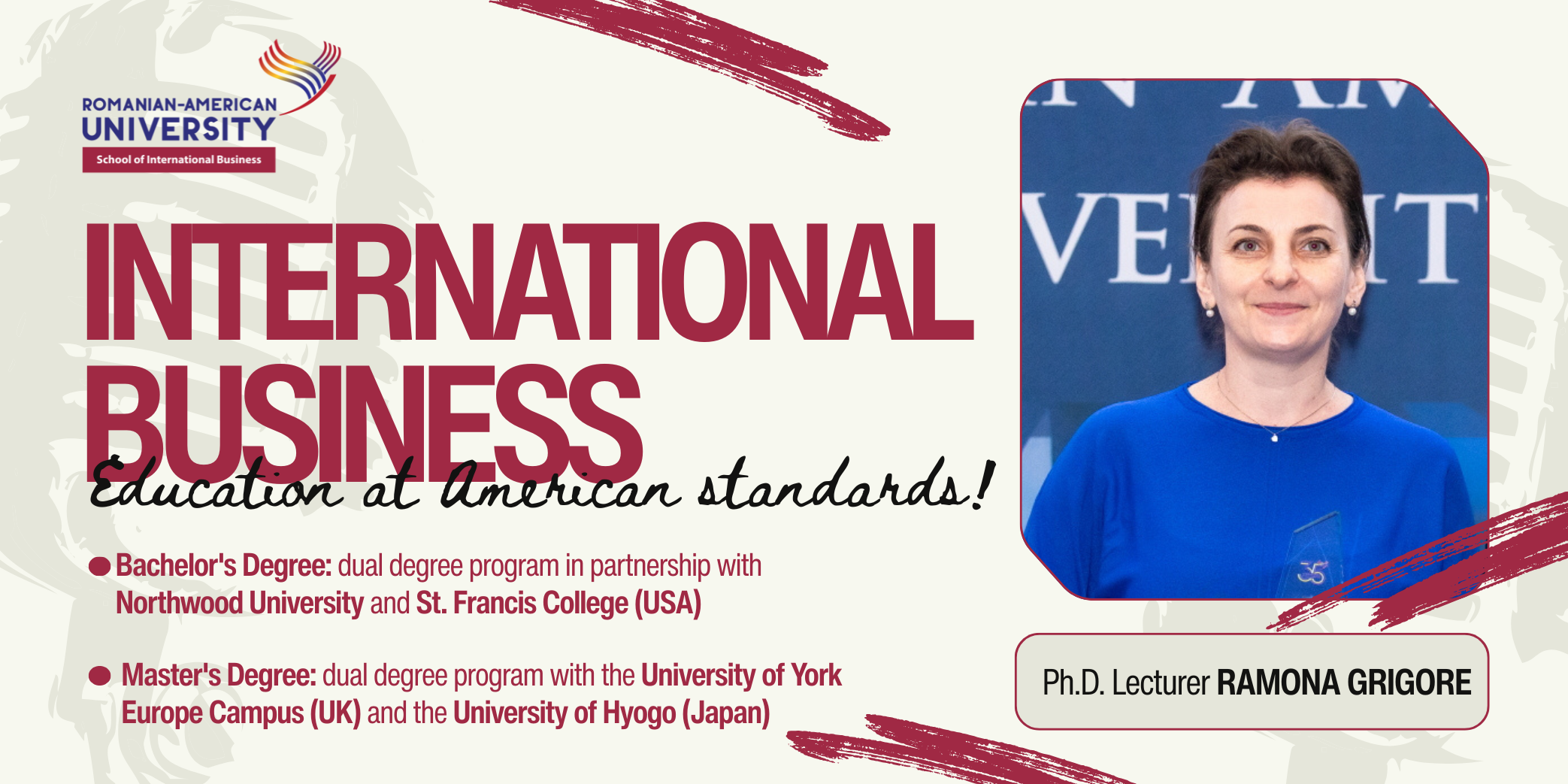
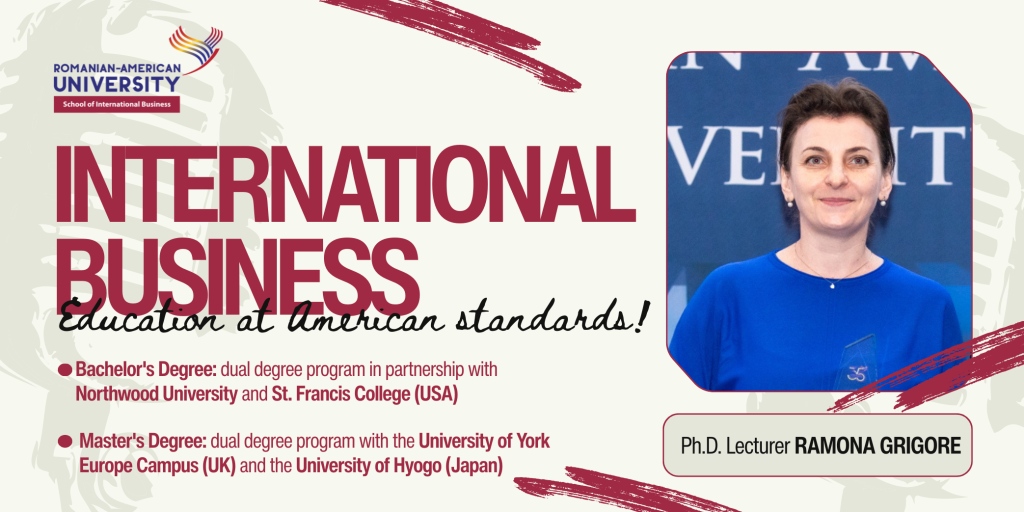
From study opportunities in the United States, Japan, and the United Kingdom to internships and careers with international organizations, the Faculty of International Business offers students a truly global learning experience. Ramona Grigore, Dean of the Faculty, shares how the program prepares future graduates to thrive in an increasingly interconnected world.
The field of International Business sounds fascinating, but it can seem abstract to a high school student. What exactly does a student learn here, and how does the Romanian-American University’s approach stand out on the market?
International business is a multifaceted field that seamlessly integrates economics, law, finance, marketing, and management with cross-cultural communication and strategic planning. Developing expertise in these areas is crucial for cultivating a strategic mindset, enabling future professionals to innovate and lead effectively within today’s complex and dynamic global economy.
Whether our students aspire to launch their own entrepreneurial ventures, excel within multinational corporations, or enter the field of economic diplomacy, our curricula are structured to provide a comprehensive theoretical foundation paired with extensive practical exposure. What truly sets us apart is our competitive edge in networking and internationalization. Through an expansive network of partnerships across Europe, the United States, Japan, and South Korea, our students regularly engage in high-impact study and internship mobilities. These immersive multicultural experiences not only enrich their academic journey but also offer prestigious opportunities to earn double degrees from renowned partner institutions in the US, Japan, and the UK.
The university’s name carries a strong promise regarding the American educational model. How is this reflected in your school’s courses? Do you offer programs taught exclusively in English, and how much emphasis do you place on experiential learning over traditional theory?
We are a community that values partnership with students, educational quality, diversity, relationships with business partners, integrity, and mutual respect—all of which align with the core principles promoted by the American educational system. In everything we do, we are guided by our students’ personal and professional development needs, providing them with a harmonious learning environment and multiple opportunities to leverage their potential and discover or refine their skills.
The international openness of the School of International Business is directly supported by our programs taught entirely in English, both at the undergraduate and graduate levels.
For undergraduate studies, we offer the International Business program, which features a double-degree track in partnership with Northwood University and St. Francis College in the USA.
At the master’s level, our offerings include International Business and Entrepreneurship, a double-degree program with the University of Hyogo in Japan, International Economic Relations and EU Studies, a double-degree program with the University of York Europe Campus in the UK, as well as International Economic Relations & Economic Diplomacy.
Within our school, the global dimension is embedded in everything we do—through international study and internship mobilities, courses taught by guest professors from partner universities abroad, collaborative projects with international students, and events organized in partnership with embassies, chambers of commerce, and professional associations from various fields of activity.
What type of student thrives most in this environment? What traits or interests should a high school graduate possess to truly feel “at home” at the School of International Business?
This domain is ideally suited for analytical and ambitious high school graduates eager to understand how modern enterprises operate, scale, and generate sustainable social impact on a global scale. Students who thrive in our community typically exhibit a keen interest in global economic trends, a passion for exploring diverse cultural landscapes, and an innate drive to collaborate in international teams or pilot their own business concepts.
Beyond economic theory, what concrete competencies and soft skills do you prioritize to ensure graduates are fully prepared for the fast-paced corporate world?
While a rigorous understanding of international trade and macroeconomic structures is essential, our academic framework places a heavy premium on high-demand transversal skills. Throughout their studies, students refine their capacity to negotiate in multicultural corporate environments, practice agile decision-making, and exercise leadership within diverse teams.
Furthermore, we heavily integrate digital literacy and technological fluency into our business development modules. This balanced approach ensures our graduates possess the precise portfolio of strategic and interpersonal competencies that leading multinational employers look for.
International Business cannot be mastered solely within a classroom. What global mobility opportunities do your students have, and how vital is international exposure to their degree?
True expertise in global markets requires firsthand international exposure. We view study abroad opportunities not as an luxury, but as a core component of the educational ecosystem.
Through our corporate and academic alliances, we offer robust access to international exchange frameworks, particularly via the Erasmus+ program, alongside collaborative global classrooms. Combined with our dual-degree options in the US, East Asia, and the UK, these pathways provide students with the cross-border agility necessary to secure high-tier international career placements immediately upon graduation.
Campus life extends far beyond regular lecture hours. What extracurricular networking and community-building opportunities exist from day one?
The university experience is a pivotal era for personal branding and networking, and our extracurricular framework is designed to mirror professional business ecosystems. We regularly host business masterclasses, corporate roundtables, case study competitions, and dedicated career placement forums.
Students are encouraged to take proactive leadership roles within our structured student organizations—such as the CS-URA Students Club, the International Students Club, and the Art Club—or engage in specialized projects spearheaded by our institutional research centers, including the Department of Asian Studies, the Center for Latin American Studies, and the Department of American Studies.
How integrated is the School of International Business with the contemporary corporate landscape? How do you facilitate direct recruitment from the lecture halls?
We maintain deeply institutionalized partnerships with a vast network of multinational corporations, public agencies, and trade organizations. The mandatory internship modules integrated into our programs offer students a transparent view of corporate structures, operational workflows, and strategic decision-making.
For a substantial majority of our student body, these corporate placements serve as a direct pipeline to part-time or full-time career roles prior to graduation. Our frequent on-campus recruitment fairs and corporate networking days further ensure that industry talent acquisition managers interact directly with our students throughout the academic year.
For parents evaluating the long-term return on investment of this degree, what are the primary career trajectories for your graduates? Does the curriculum cater to entrepreneurial paths as well as corporate placement?
The versatile architecture of an international business degree unlocks an exceptionally broad spectrum of professional opportunities. Our alumni successfully pivot into two primary tracks: launching innovative startups as independent entrepreneurs, or ascending through specialized corporate tracks within global multinational firms—specifically in business development, international marketing, corporate finance, and strategic human resources.
Additionally, our graduates are highly competitive candidates for prestigious roles within international development organizations, European Union institutions, and the diplomatic corps.